20
2026
-
01
Focus on the recycling of waste acids and bases, and membrane separation technology empowers green production
Author:
In the context of the rapid global industrial development, the emissions of waste acids and waste bases are increasing day by day, posing a significant challenge to the ecological environment and the sustainable utilization of resources. Traditional treatment methods such as neutralization and precipitation, as well as incineration, not only consume a large amount of energy and chemical reagents, but also cause secondary pollution and exacerbate resource waste. Membrane separation technology, with its physical separation characteristic driven by concentration gradients, and with the advantages of low energy consumption, no chemical additives, and high recovery rate, has become the core technology in the field of waste acid and waste base resource recovery, providing key support for the green transformation of industry.
I. Core Technology: Ion Selective Migration Driven by Concentration Gradient
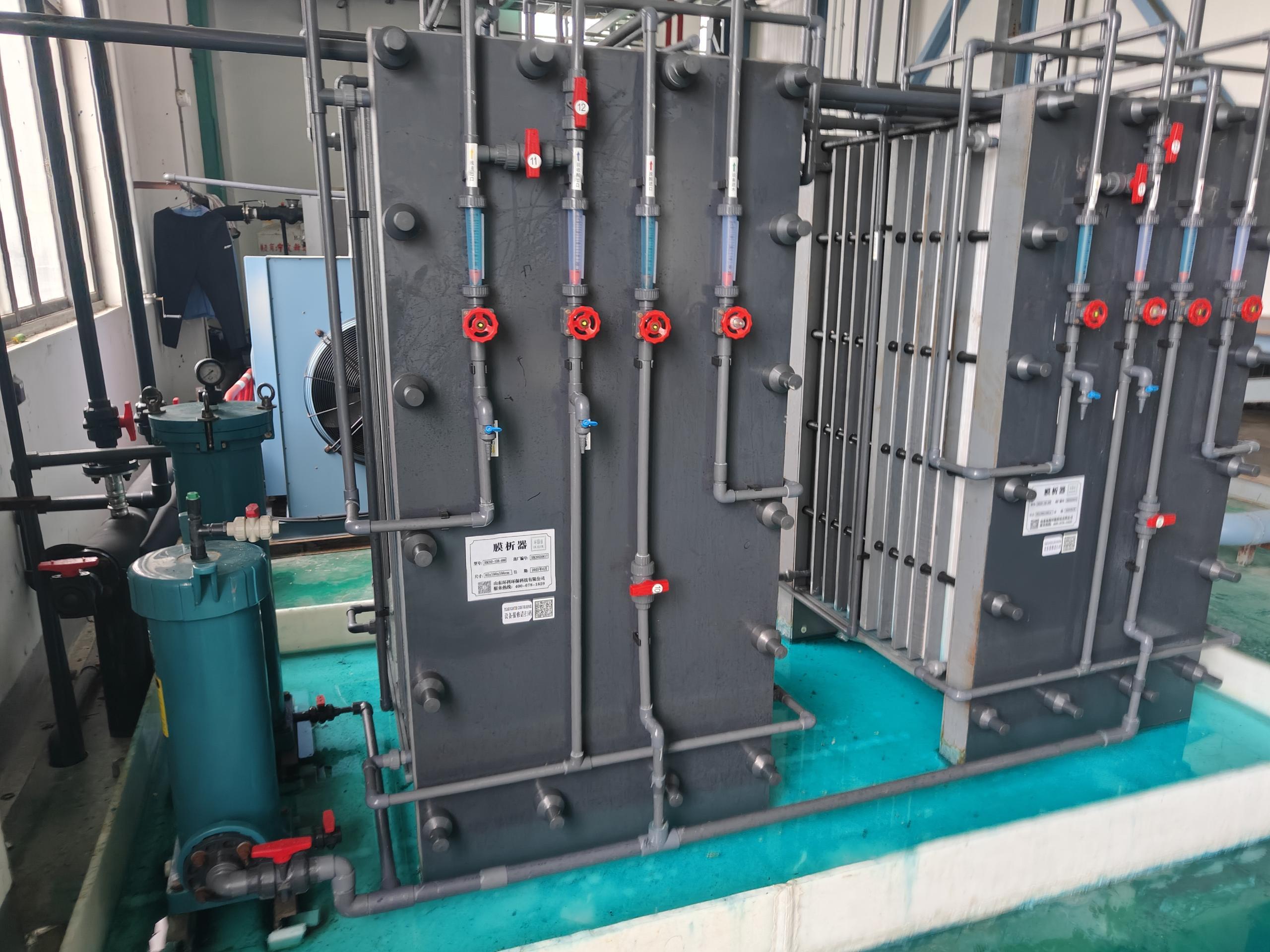
The core of membrane separation lies in the selective permeability of the ion exchange membrane and the synergy of concentration gradients. When waste acids (or waste bases) with different concentrations and the receiving liquid (such as water) are separated by the ion exchange membrane, solute ions, driven by the concentration difference, migrate from the high-concentration side to the low-concentration side. This process does not require external electric fields or high temperatures and pressures, but only relies on natural diffusion for separation, embodying its essence of "green physical separation".
The selectivity of the ion-exchange membrane is the key to the technical implementation. Under acidic conditions, the anion exchange membrane (with positive charge) allows sulfate ions (SO₄²⁻), chloride ions (Cl⁻), and other anions to pass through, while repelling metal cations (such as Fe²⁺, Cu²⁺). Since hydrogen ions (H⁺) have a small hydration radius and few charges, their migration rate is much higher than that of metal ions. Therefore, the effective acid components in the waste acid (such as H₂SO₄, HCl) can preferentially pass through the membrane and be separated from the metal salts. In alkaline conditions, the cation exchange membrane (with negative charge) allows sodium ions (Na⁺), potassium ions (K⁺), and other cations to pass through, while repelling anions (such as WO₄²⁻, CO₃²⁻), enabling the recovery of alkali components such as sodium hydroxide (NaOH), sodium carbonate (Na₂CO₃).
The continuous driving force of the concentration gradient is the guarantee for the efficient operation of the technology. As the separation progresses, the concentration difference between the two sides of the membrane gradually decreases. However, by using the counter-current operation (where the waste liquid and the receiving liquid flow in opposite directions), a local concentration difference can be maintained, ensuring the continuous progress of the separation process. Moreover, the "molecular sieve" effect of the membrane channels further enhances selectivity - the matching of pore size with the hydration radius of ions, allowing small molecule ions (such as H⁺ and OH⁻) to pass through first, while large molecule ions (such as metal salts) are retained, significantly improving the recovery purity.
II. Resource Recovery: A Leap from "End-of-Pipe Treatment" to "Circular Utilization"
The application of membrane separation technology in the recovery of waste acids and waste bases has achieved a fundamental transformation from "pollution discharge" to "resource regeneration", and its value is reflected in the economic, environmental and resource dimensions.
Economic Value: Reduces production costs and generates direct profits. Taking the acid washing waste liquid from the steel industry as an example, the traditional lime neutralization method requires a large amount of lime (about 0.3 tons of lime per ton of waste acid) and produces nearly 10,000 tons of gypsum waste residue, with a processing cost of several million yuan per year. After adopting membrane separation technology, the recovery rate of sulfuric acid in the waste acid can reach 80%-90%, and the concentration of recovered acid can be increased from 18% to 32%. The recovered acid can be directly reused in the acid washing process, reducing the purchase volume of fresh acid; at the same time, the separated metal salts (such as ferrous sulfate) can be further purified into chemical raw materials (such as iron oxide red), creating additional value. After applying this technology in a certain chemical plant, the annual savings in processing costs exceeded 3 million yuan, and the investment payback period was shortened to 2.3 years, resulting in significant economic benefits.
Environmental Value: Reducing pollution emissions and lowering ecological risks. The waste residues produced by traditional methods (such as calcium sulfate and iron hydroxide) if not handled properly, can easily cause soil compaction and water body eutrophication; incineration methods may release harmful gases such as sulfur dioxide (SO₂) and nitrogen oxides (NOₓ). Membrane separation technology achieves resource recovery through physical separation and almost does not cause secondary pollution. For example, in the treatment of electroplating wastewater, this technology can recover heavy metal ions (such as nickel and copper) as raw materials to be re-invested in production, avoiding long-term pollution of heavy metals to the soil and water bodies; in the treatment of pharmaceutical wastewater, high-concentration organic matter and salts can be separated out, reducing the load of subsequent biochemical treatment and reducing COD (Chemical Oxygen Demand) and toxic substance emissions.
Resource Value: Promoting Circular Economy and Alleviating Resource Pressure. The global consumption of acid and alkali resources is enormous. Membrane separation technology can reduce reliance on primary resources by recovering the effective components from waste liquids. For instance, recycling 1 ton of sulfuric acid can save approximately 0.8 tons of sulfur ore, reducing energy consumption (such as mining and smelting) and carbon emissions; recycling 1 ton of sodium hydroxide can save about 1.5 tons of sodium chloride (table salt), reducing the ecological impact of salt lake extraction. Moreover, this technology is adaptable to raw materials and can handle high-concentration and complex-component waste liquids (such as mixed waste liquids containing organic substances and heavy metals), further expanding the scope of resource recovery.

III. Technological Optimization: Upgrade from Single Separation to System Integration
To enhance the efficiency and adaptability of membrane separation technology, researchers have conducted in-depth optimization in three aspects: membrane materials, process flow, and system integration.
Innovations in membrane materials: Enhancing selectivity and anti-pollution properties. Traditional ion-exchange membranes (such as polysulfone quaternary ammonium anion membranes) suffer from problems like swelling and easy contamination, which limit their long-term operational stability. The new homogeneous membranes have significantly improved the chemical stability (resistance to acids and alkalis, resistance to organic solvents) and mechanical strength (tensile strength > 20 MPa) of the membranes, while reducing the swelling rate (< 5%). For specific waste liquids (such as waste acids containing organic substances and colloids), anti-pollution membranes have been developed. These membranes reduce membrane surface adsorption through surface coatings (such as polytetrafluoroethylene) or nano-modifications (such as silica nanoparticles), extending their service life to over 18,000 hours.
Process flow collaboration: Establish a hierarchical recycling system. By coupling membrane separation with other technologies (such as ultrafiltration, nanofiltration, and electrodialysis), multi-component deep separation in waste liquids can be achieved. For example, in the recovery of rare earth waste acid, first, large molecule impurities (such as proteins and starch) are removed through ultrafiltration, then divalent and higher ions (such as Ca²⁺ and Mg²⁺) are retained by nanofiltration, and finally, monovalent ions (such as H⁺ and Cl⁻) are deeply removed by membrane separation, resulting in an acid recovery purity of over 99.5%; in the recovery of chemical waste alkali, combined with evaporation crystallization technology, the alkali solution after membrane desalination is concentrated to a high concentration (such as 50% NaOH), meeting industrial-grade requirements.
Intelligent system integration: Achieving dynamic optimization and remote monitoring. By continuously monitoring parameters such as membrane stack voltage, flow rate, and conductivity, the system can automatically adjust operating conditions (such as temperature and flow rate) to ensure continuous operation under the optimal conditions. For instance, a chemical plant using variable frequency pumps and plate heat exchangers controlled the flow rate within 0.8-1.2 m³/h and maintained the temperature at 25 ± 2℃, resulting in a stable sulfuric acid recovery rate of over 83%. Combined with machine learning algorithms, it can predict membrane contamination trends and intervene in advance (such as automatic backwashing), reducing the membrane performance degradation rate by over 40%. Moreover, the remote monitoring platform can provide real-time feedback on equipment status and issue fault warnings, reducing downtime and improving operational efficiency.
IV. Application Expansion: Penetration from Traditional Industries to Emerging Fields
The advantages of membrane separation technology have enabled its wide application in traditional industries such as steel, chemical engineering, and electroplating. At the same time, it is gradually penetrating into emerging fields such as new energy, environmental protection, and biomedicine.
In the field of new energy, the lithium-containing waste liquid (such as Li₂CO₃ and LiOH) generated during the production of lithium batteries can be recovered for lithium resources through membrane separation, reducing dependence on lithium mines. In the photovoltaic industry, the hydrogen fluoride (HF) and nitric acid (HNO₃) in the waste liquid from silicon material cleaning can be recycled, which can lower production costs and reduce fluoride emissions. In the environmental protection field, the high-concentration ammonia nitrogen (NH₄⁺) and organic matter in the landfill leachate can be separated through membrane separation to obtain ammonia water as a fertilizer raw material, achieving the transformation of waste into treasure. In the biomedicine field, the organic acids (such as lactic acid and citric acid) in the fermentation liquid can be recovered, which can improve product purity and reduce the energy consumption for downstream purification.
V. Future Outlook: A Green Future Driven by Technological Iteration and Policy Incentives
With the global emphasis on carbon neutrality and circular economy, membrane separation technology will have a broader development space. On one hand, the continuous innovation of membrane materials (such as developing high-throughput, high-selectivity, and low-cost composite membranes) will further enhance the technical efficiency and economy; on the other hand, policy support (such as carbon trading, green credit) and standard improvement (such as indicators for the recovery rate of waste acid and waste alkali) will promote the large-scale application of the technology. It is expected that by 2030, the penetration rate of membrane separation technology in the global waste acid and waste alkali recovery market will exceed 40%, becoming one of the core technologies for industrial green transformation.
From "end-of-pipe governance" to "source reduction", from "resource consumption" to "recycling and regeneration", membrane separation technology, with its unique physical separation mechanism and wide adaptability, provides an efficient and environmentally friendly solution for the resource recovery of waste acids and bases. Under the dual influence of technological iteration and policy-driven measures, this green engine will surely accelerate the low-carbon transformation in the industrial sector and contribute to building a sustainable future.
Related Products

Huanke Environmental Protection Technology
HOTLINE:
Address:Optoelectronic Industry Accelerator in Weifang Hi-Tech Zone, Shandong Province, China
Contact:Zhang Gong
WhatsApp:+8619953608211
Email:eco.eqpt@gmail.com
Consult
TikTok
Copyright © 2023 Shandong Huanke Environmental Protection Technology Co., Ltd