19
2026
-
01
Analysis: A Green Technological Path for Recovering Sulfuric Acid from the Wood Sugarization Solution by Using Concentrated Sulfuric Acid
Author:
In the wood sugarization industrial production, the concentrated sulfuric acid method is the traditional core process for promoting the hydrolysis of cellulose to generate monosaccharides such as glucose. However, this process generates a large amount of sulfuric acid-containing waste liquid. If such waste liquid is directly discharged without proper treatment, it not only causes a serious waste of sulfuric acid resources, but also triggers a series of severe environmental problems such as soil acidification and water pollution. Membrane separation technology, with its outstanding advantages of efficient separation and energy conservation and environmental protection, has become an ideal solution for recovering sulfuric acid from such waste liquid, opening up a green and feasible path for the resource utilization of industrial waste liquid.
I. Technical Principle: Innovative membrane separation driven by concentration difference
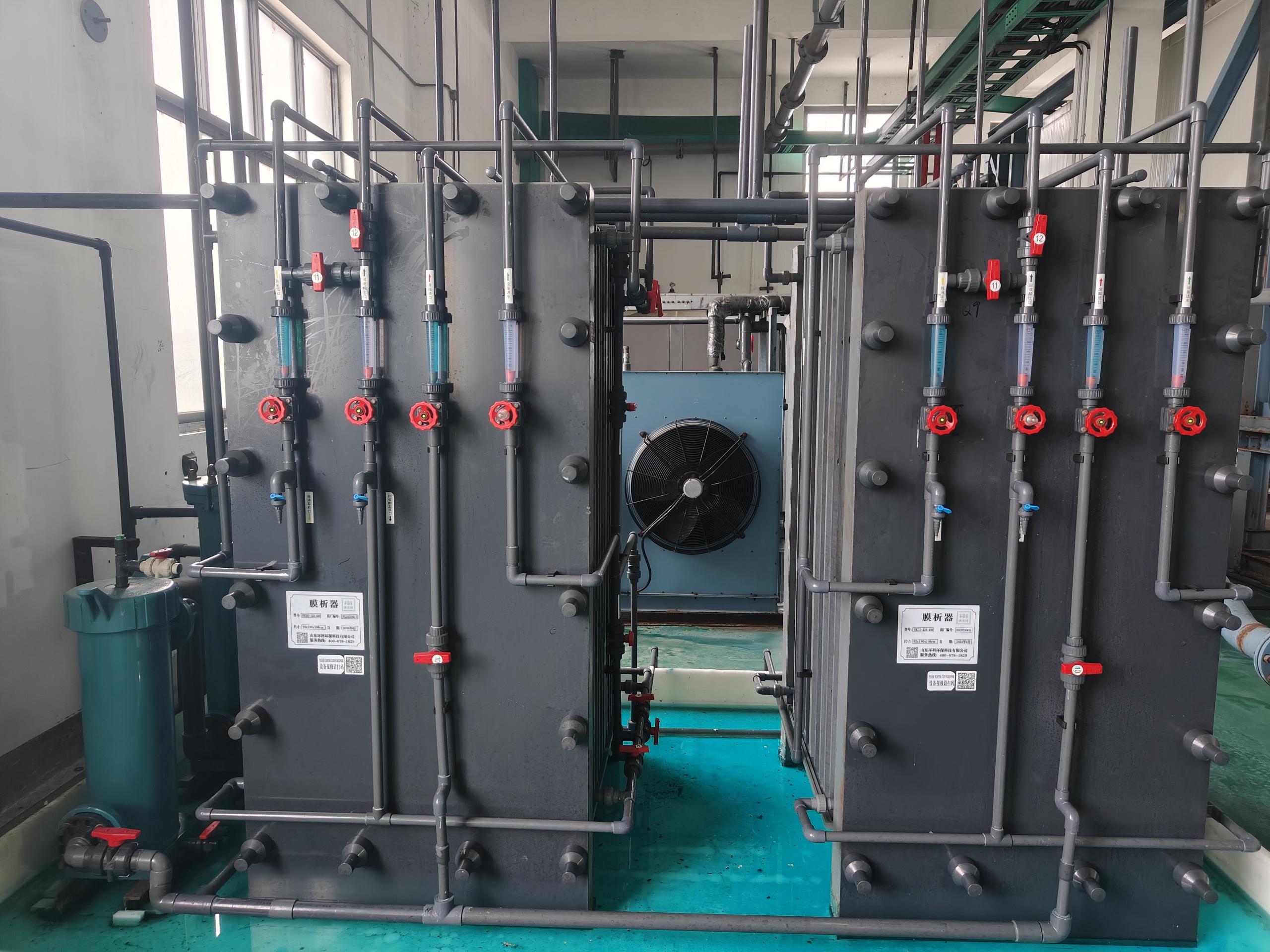
Membrane separation is a membrane separation technology based on the natural concentration gradient. The core is the selective permeability of the positively charged anion exchange membrane. The sulfuric acid concentration in the wood sugarization waste liquid is higher than that in the receiving liquid. Under the drive of concentration difference, sulfate ions are adsorbed by the membrane and migrate to the receiving liquid, while hydrogen ions migrate simultaneously; positively charged metal ions and other impurities are excluded and retained by the membrane. The hydroxide ions in the receiving liquid migrate in the opposite direction to the original liquid chamber and combine with hydrogen ions to form water, ultimately achieving efficient separation of sulfuric acid and impurities.

II. Technical Advantages: Balancing Environmental Value and Economic Benefits
1. Efficient Separation, Achieving Resource Recycling
The membrane separation technology, based on the selective permeability of membranes, enables high-precision separation of sulfuric acid and metal ions, as well as organic substances from the waste liquid produced during wood saccharification. In the application of treating wood saccharification waste liquid, the recovery rate of sulfuric acid can reach over 80%, which can be directly reused in the saccharification process, significantly reducing the cost of purchasing fresh sulfuric acid. At the same time, the retained impurity solutions can be further processed through subsequent techniques such as chemical precipitation and ion exchange to achieve the recovery of metal resources, establishing a "sulfuric acid - metal" dual-resource recycling system.
2. Energy conservation and environmental protection, reduced operating costs
This technology does not require strict reaction conditions of high temperature and high pressure. It only relies on the natural concentration difference as the driving force, with energy consumption being only 1/5 - 1/10 of that of the traditional evaporation crystallization method. Moreover, no chemical reagents are added during the membrane separation process, which eliminates the risk of secondary pollution from the source and fully conforms to the concept of green chemistry. Based on the calculation of treating 100 tons of wood saccharification waste liquid per day, the application of membrane separation technology can reduce approximately 500 tons of carbon dioxide emissions annually, decrease the hazardous waste disposal volume by 60%, and reduce the wastewater treatment cost by more than 30%.
3. Stable operation, long service life of membrane components
The membrane separation equipment has a simple structure, mainly consisting of membrane components, partitions, clamping devices, etc. The daily maintenance cost is low. Currently, the service life of commercial anion exchange membranes can reach 3-5 years, and the membrane performance is stable and has strong anti-pollution ability, which can meet the requirements of long-term continuous operation. For example, a certain enterprise uses membrane separation technology to treat wood saccharification waste liquid. After the equipment operated continuously for 2 years, the membrane performance attenuation rate was less than 5%, and the recovered sulfuric acid concentration remained above 20%, fully meeting the production process requirements.
III. Future Development Direction
Membrane separation technology, with its unique separation mechanism and broad application prospects, is becoming the "green engine" in the field of waste acid recovery from wood saccharification industry. Driven by the "dual carbon" goals and circular economy policies, this technology not only helps enterprises reduce production costs and alleviate environmental pollution pressure, but also promotes the entire industry to transform towards a green model of efficient resource utilization. In the future, with the continuous breakthroughs in membrane material science and process engineering technology, membrane separation technology is expected to be applied in a wider range of industrial fields such as chemical engineering and rare earth smelting, injecting continuous power into global environmental protection and resource recycling.
Related Products

Huanke Environmental Protection Technology
HOTLINE:
Address:Optoelectronic Industry Accelerator in Weifang Hi-Tech Zone, Shandong Province, China
Contact:Zhang Gong
WhatsApp:+8619953608211
Email:eco.eqpt@gmail.com
Consult
TikTok
Copyright © 2023 Shandong Huanke Environmental Protection Technology Co., Ltd